
But is that really what children need to learn?
I don’t think it’s quite that simple.
For me, a calm learning environment isn’t necessarily a quiet one. It’s a place where a child
feels safe, comfortable and happy to explore. There might be laughter, movement, questions, toys on the floor, or even a little mess. And that’s okay.
Because before we think about how children learn, I believe we need to think about how they feel.
We’re all learning, even as parents
First of all, I would like to remind parents of something important.
We are all doing our best. We are all learning, and we all make mistakes.
Sometimes, at the end of the day, we think about the things we didn’t manage to do, or
something that didn’t go quite as we hoped. Perhaps we lost our patience, or an activity we
planned didn’t work out.
And sometimes we feel guilty.
I think it’s natural to have those feelings. But I also believe it’s important to notice the good
things that happened during the day, even the very small ones.
And when something doesn’t work, we can try a different way tomorrow. If that doesn’t work
either, we can try something else.
We don’t always have to hide these moments from our children. They can see that adults
have feelings, make mistakes and learn from them too. We can show them how we try
again, or how we put things right when we need to.
Perhaps that’s an important part of learning in itself.
Learning doesn’t always need a table and chair
I don’t believe young children need to sit at a table to learn.
Of course, as children grow older and begin developing more formal writing and study
habits, having a suitable space and some structure becomes increasingly important.
But when children are little, learning happens everywhere.
At the kitchen table. On the living room floor. In the garden. On a walk.
Sometimes, they don’t even realise they’re learning.
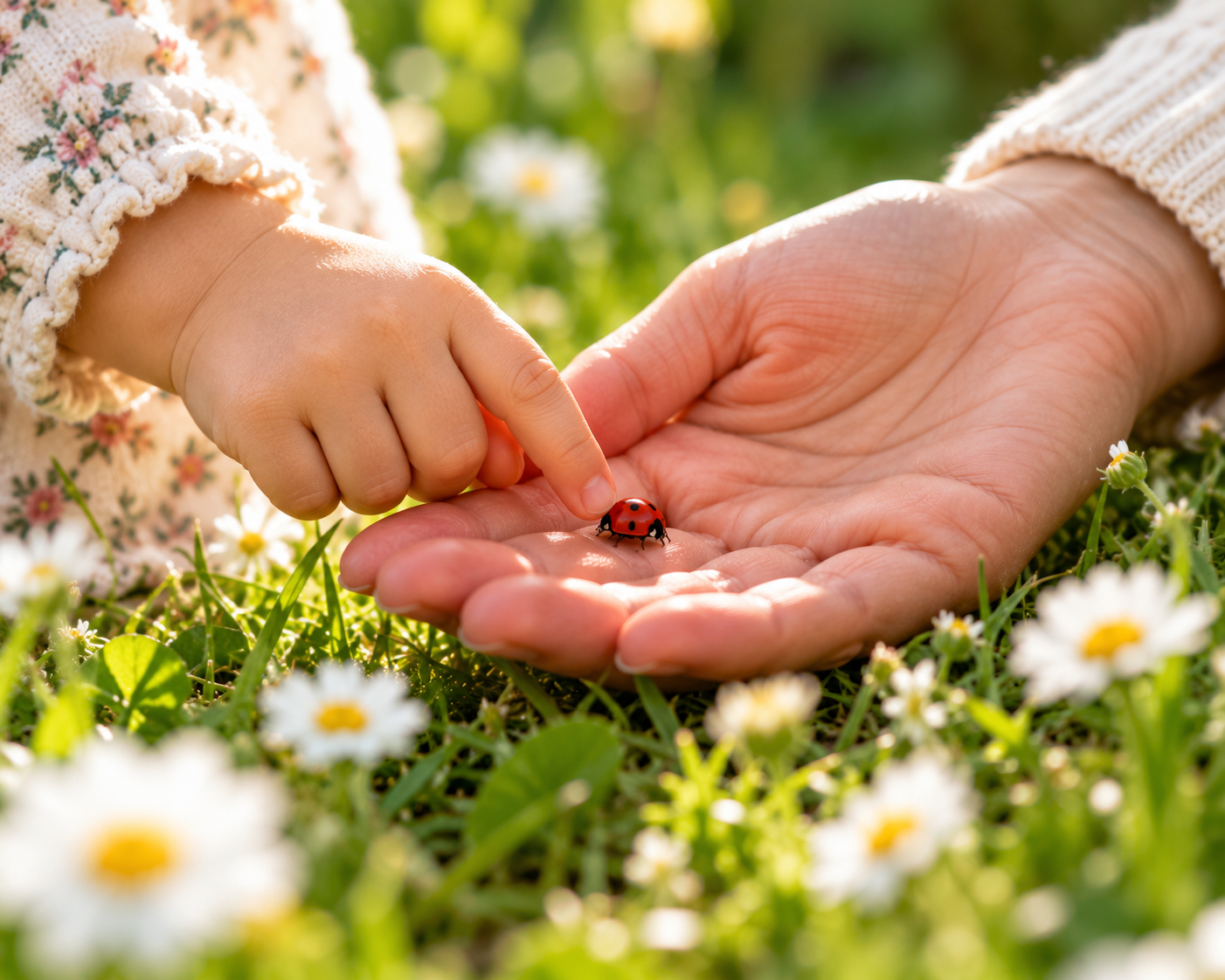
Imagine you’re walking with your child and you notice a little ladybird.
Your child stops, looks closely and begins asking questions.
Where is it going? Why does it have spots? Can it fly?
And suddenly, you’re having a lovely conversation. You’re looking, wondering, counting,
asking questions and discovering something together.
You didn’t plan a lesson. You didn’t need any special equipment.
You simply noticed an opportunity and followed your child’s curiosity.
I think these little everyday moments are so valuable. Young children are constantly noticing
things, exploring and making connections with the world around them.
And very often, play is how that learning begins.
Every child is different
One thing I’ve learnt through my years of working with children is that there isn’t one
approach that works for everyone.
Every child is an individual.
Some children enjoy learning with lots happening around them. Others find too much noise
or too many distractions overwhelming.
One child might need movement and opportunities to explore. Another might prefer a quiet
corner where they can concentrate.
And sometimes, the same child needs different things on different days.
I think our job as adults is to notice these differences and try to understand what helps each
child feel comfortable.
How do we know when a child is ready to learn?
Often, we see it in their curiosity. They begin asking questions, exploring, joining in or
showing an interest in something new.
But not every child shows excitement in the same way. Some are quieter and need a little
more time before they feel ready to take part.
That’s why I believe observing and listening to children is so important.
What if today just isn’t the right day?
We all have days when we feel tired, distracted or simply not in the mood for something.
Children do too.
If a child is struggling to concentrate or doesn’t want to join an activity, I don’t believe forcing
them is the answer.
Sometimes, pushing too hard can create resistance and make learning feel like something
unpleasant.
Instead, I might change the activity. Perhaps we could approach the same idea through a
game, movement or a little conversation.
Or maybe we just need a break.
And sometimes, it’s perfectly fine to leave something until tomorrow.
That doesn’t mean we’ve given up. It means we’re recognising what the child needs at that
moment.
Of course, there are things children need to learn and responsibilities we need to help them
develop. But I believe we can guide them towards those things with patience and
understanding.
Learning doesn’t have to be a battle.
The comfort of familiar routines
I also believe that familiar routines play an important part in helping children feel secure.
Not because every day needs to follow a strict timetable, but because children benefit from
knowing what to expect.
Simple things like getting up in the morning, having meals, getting ready for the day and
preparing for bedtime can give a familiar rhythm to family life.
Of course, plans change. Sometimes something unexpected happens, and sometimes it’s
lovely to do things differently.
Children need to learn how to manage those changes too.
But I think it’s easier to be flexible when we have familiar routines to return to.
For some children, including children with special educational needs, knowing what will
happen next can be especially reassuring.
It’s something I’d love to talk about more in another Journal, because routines deserve a
conversation of their own.
Sometimes, a little space makes all the difference
I remember working with children who sometimes found it difficult to settle or concentrate in the classroom.
For some of them, having their own little corner or a small box containing familiar, important
things made a real difference.
When everything around them felt a little too much, they could spend a few minutes in that
space or with those belongings.
It wasn’t a punishment, and it wasn’t about stopping them from learning.
It was simply a way of helping them feel comfortable again.
And often, after those few minutes, they were ready to return and join in.
I think this is something we can remember at home too.
Sometimes, children don’t need us to do more. They need us to notice what they’re feeling
and give them a little space.
Seeing the world through their eyes
If there is one thought I’d like parents to take away from this Journal, it’s this:
Sometimes, we need to allow ourselves to be children alongside our children.
I don’t mean forgetting our responsibilities as adults.
I mean trying, just for a moment, to see the world as they see it.
To notice the tiny ladybird.
To understand why a game feels so important.
To remember how big a small disappointment can feel when you’re little.
And perhaps, instead of always expecting children to see things from our point of view, we
could sometimes try to see things from theirs.
A calm learning environment doesn’t need to be perfect. Neither do we.
For me, what matters most is that children feel safe, understood and comfortable enough to
be curious, make mistakes and try again.
Because isn’t that where so much of learning begins?
Eva 🌸
Tiny Smiles Club