
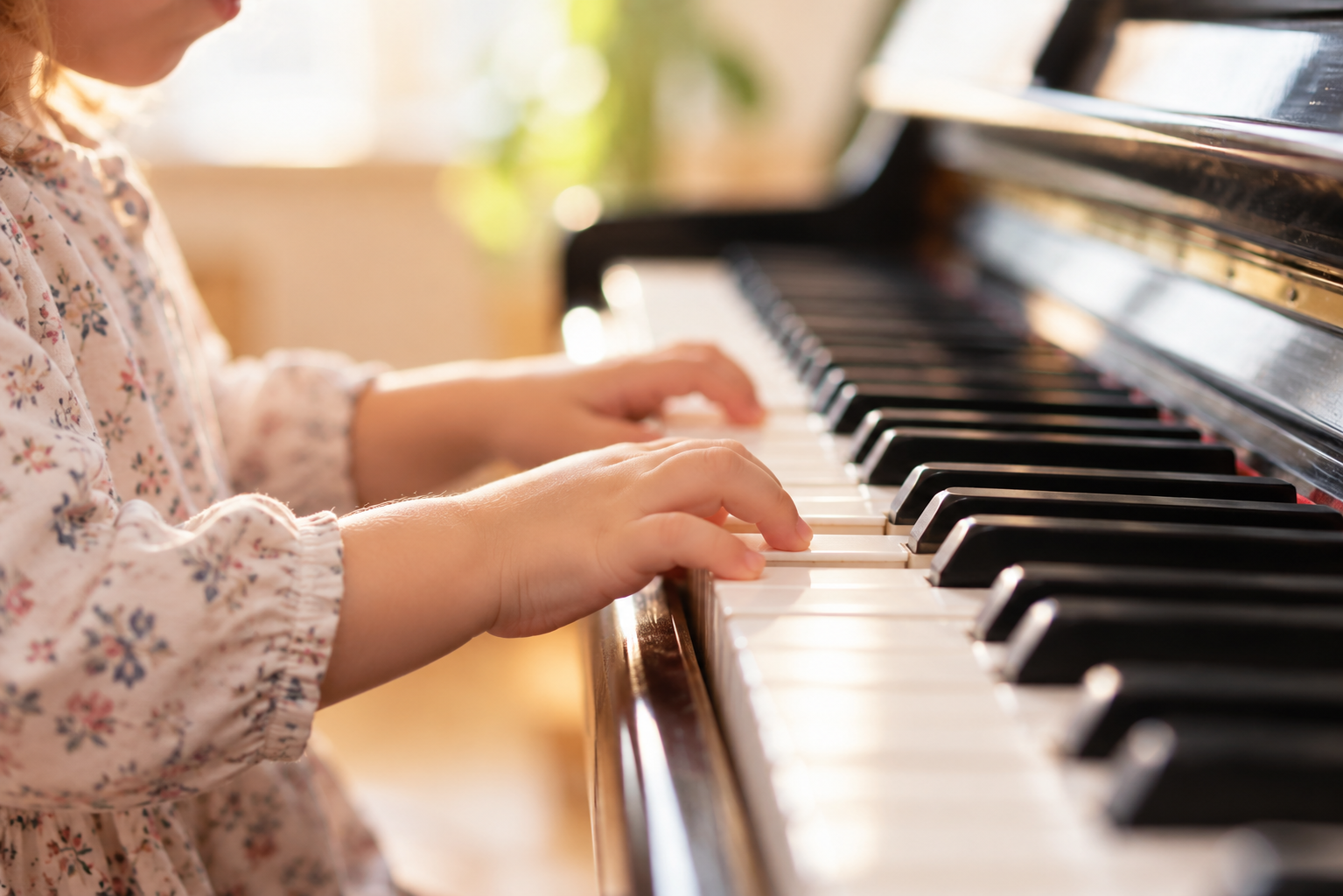
For me, four can be a wonderful age to begin. But I also believe there isn’t one perfect age
that suits every child. Every child is different, and their relationship with music begins long
before they ever sit down at a piano.
In fact, I like to think that our musical journey starts before we are even born.
From the earliest days, children are surrounded by sounds, voices and rhythm. Later, music
can become part of everyday family life very naturally — a parent singing a little song,
listening to music together, clapping a rhythm or simply dancing around the kitchen.
These may seem like very small things, but they are all helping to build a child’s relationship
with music.
This idea of beginning music early is also very close to the philosophy of Hungarian
composer and music educator Zoltán Kodály, whose approach has influenced my own
music teaching. Singing has a particularly important place in the Kodály approach. Our voice is the first musical instrument we all have, and through singing, listening, rhythm and
movement, children can experience music naturally before they need to understand written
notes or musical theory.
Most importantly, I believe these early experiences should be joyful.
So, how do I know if my four-year-old is ready?
Perhaps your child loves singing.
Perhaps they stop and listen when they hear music, enjoy moving to a song or try to copy a
rhythm.
Or perhaps the biggest clue is simply curiosity.
They see a piano and want to touch it. They wonder what will happen if they press one of
those keys. They want to discover how that big instrument can make so many different
sounds.
For me, that curiosity is enough.
A four-year-old doesn’t need to arrive at their first lesson already knowing something about
music. I don’t expect them to read notes. I don’t expect a long attention span. And I certainly
don’t expect them to sit perfectly still at the piano for an entire lesson.
They are four.
My job is to meet them where they are.
A piano lesson doesn’t have to mean sitting at the piano
When I teach a very young beginner, playfulness is incredibly important.
We explore the piano and discover its different sounds. We sing. We play rhythm games. We
listen to music. We move. We might use scarves or other simple props.
And, of course, we play the piano too.
For a young child, these things aren’t separate from learning music.
They are the learning.
Young children learn so much through play, movement, repetition, listening and discovery.
So I don’t feel that we need to hurry.
There will be plenty of time for everything else.
First, I want a child to discover that music is something they can enjoy.
What about Mum or Dad?
Parents sometimes wonder whether they should stay during their child’s piano lesson.
My answer is very simple:
It depends on your child.
Some young children feel much safer when their parent is nearby, particularly at the
beginning. Having that familiar person in the room can give them the confidence they need
while they explore a new environment and get to know me.
Then, as their confidence grows, something lovely can happen. One day they realise that
they are perfectly happy to come in without Mum or Dad.
Other children are completely different and may concentrate more easily when their parent
isn’t in the room.
There is no single rule that works for every family.
Parents know their children best, and I believe we should work together to find what helps
each individual child feel happy, secure and ready to learn.
It’s about much more than playing the right notes
This is one of the reasons I love introducing music to young children.
I am never only teaching piano.
Over the years, I have watched music encourage children to listen and concentrate. It can
help develop coordination, creativity and confidence. It gives children opportunities to
express themselves and to experience that wonderful little feeling of:
“I can do this!”
For a shy child in particular, music can sometimes offer another way of opening up and
expressing themselves.
A child doesn’t necessarily need the words to say, “Look what I can do.”
Sometimes they can play it.
And those little moments matter to me.
So, are they ready?
So, is your four-year-old ready for piano lessons?
Perhaps we don’t need a long checklist to find out.
It’s not about what they can do yet. It’s about what they want to discover.
Maybe they are curious about the piano. Maybe they want to press those keys and find out
what sounds they can make. Maybe they simply want to have a go.
And sometimes, that’s all we need for a beginning.
One little sound can become another… and another.
And sometimes, that is how a lifelong love of music begins.
Because how do we know until they try?
Eva 🌸
Tiny Smiles Club